


From Silos to Shared Intelligence: Why Agriculture Needs a Digital Backbone
By: Jen Lovequist, Vice President, Product & Engineering
Over the last several decades, the agriculture industry has generated an immense universe of digital information, from operating systems to farm management software, satellites to soil samples. Despite this profusion of information, much of this data remains fragmented across disconnected systems, constraining stakeholders across the agricultural ecosystem with incomplete insights and an imperfect understanding of on-the-ground realities.
In my experience, I’ve seen this fragmentation hamstring decision makers up and down the value chain. We see farmers left making decisions without the climate modeling tools that could help protect yields in an increasingly volatile climate. Companies must make procurement decisions on land they do not own and cannot directly measure, without a clear picture of the risk. Conservation funding that could otherwise flow to the highest-impact projects goes untapped, in part because the data needed to identify them simply isn’t connected.
To build a future that is resource abundant, we need to connect and coordinate all the data siloed across complex systems into shared intelligence. We must empower key stakeholders like farmers and companies with the funding and insights needed to make truly innovative decisions that were never possible before.
Defining the Digital Backbone
At Terion, we’re building a real-time digital representation that continuously integrates and simulates biological and environmental processes. Think of it as a shared, living picture of the whole system, connecting what’s happening on the farm (practices, soil, crops, watersheds and weather) to what’s happening around it (markets, economics, supply chains, environmental outcomes, incentives). Importantly, this living model needs to be more than a digital record of what has occurred; it should help us understand what’s happening now and why, what’s likely to happen next, and what actions will create the best outcomes.
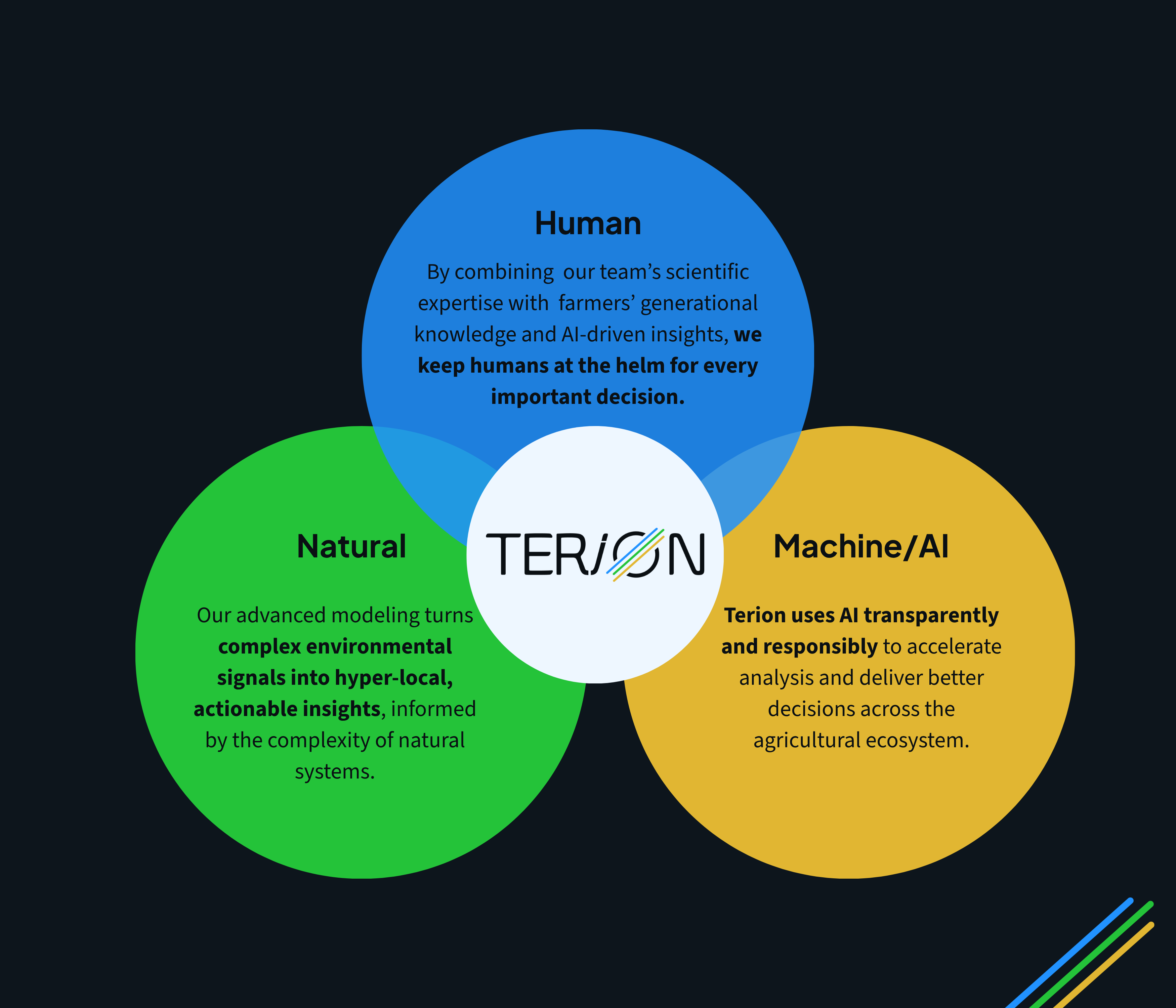
By combining human, natural and machine intelligence, we can ask critical questions like “What outcome is likely?”, “What intervention is needed?” and “What risk should be mitigated?” It effectively unlocks shared, actionable intelligence, enabling every participant – from farm to fork to fiber – to operate from the same trusted source of truth.
Take the example of an agribusiness that commits to improving input efficiencies while delivering quantified, credible outcomes for supply chain partners seeking to meet their sustainability goals. Using predictive modeling, we can identify exactly which fields, crops and regions in the supply chain stand to benefit most from applying variable rate fertilizer. The result isn't a single win, but three. Farmers spend less on inputs, the environmental footprint of that acre shrinks, and the company’s partners get real progress toward their emissions reduction targets, backed by wholly defensible data.
From Reactive to Proactive
With this digital backbone, I believe we can help the entire agricultural ecosystem shift to predictive decision-making instead of assessing impact after the fact (e.g., damage caused by drought, measuring performance after harvest, or verifying outcomes months later). For farmers, this translates into the ability to forecast yields before harvest, anticipate nutrient needs, target the best practices for the greatest impact. For companies, it means moving from simply measuring outcomes to proactively influencing them. This living, predictive model simulates outcomes for farmers across a supply shed before a single dollar is invested.
And the benefits will compound. Mitigating risk from weather across supply chains can help companies make more confident investments. With better agronomic recommendations and more granular field-specific recommendations, a company can help farmers across its supply shed conserve water, improve yield, and achieve resource efficiency, at scale. Companies can focus on initiatives that will deliver the greatest ROI and restore resilience.
Solving for Today and Tomorrow
Today’s ag industry is replete with applications and platforms that leverage data to solve a single problem, whether it’s targeting inputs, optimizing farm management, or reporting climate impact. But few players connect the entire ecosystem, and even fewer do it without bias.
One thing I've learned while building agricultural technology is that trust matters as much as technology. For this digital backbone to succeed, it must be scalable, science-based, and capable of serving multiple stakeholders simultaneously. But most importantly, it must be independent. In an increasingly complex agricultural ecosystem, neutrality matters.
Terion is not tied to input sales, commodity markets, agricultural products, sustainability credits, nor are we owned by a major agricultural incumbent. Our independence allows us to provide unbiased intelligence that organizations can trust when evaluating investments, measuring outcomes, managing risk, and designing agricultural and sustainability programs.
At Terion, we can connect fragmented data into a living, predictive model of the agricultural system, enabling better decisions for every stakeholder.
- Our team is deeply embedded across the ag ecosystem – from farmers to advisors, enterprises to government agencies – to enable acre sourcing and scalability.
- Our leading-edge science and modeling (that combines bottom-up crop, soil and ecosystem modeling with top-down remote sensing and computer vision) delivers powerful predictive analytics capabilities.
- By combining human, natural and machine intelligence in a single platform, we can accelerate analysis and improve decision making while also advancing nature-centered management on a hyper-local basis.
By serving as agriculture’s digital backbone, and providing a living model of natural landscapes, Terion can create common ground for action. What excites me most is that we now have the technical capability to connect agricultural data, science and AI in ways that weren't possible even a few years ago. Through our platform, we are building the foundation to discover and deploy the agricultural innovation needed to ensure an abundant agricultural ecosystem.
As VP of Product and Engineering, Jen Lovequist leads Terion’s cross-functional teams through the full product lifecycle—from ideation to release—while driving innovation and operational excellence. She has 12+ years leading high-performing teams across SaaS organizations.